

Alex Antonuk:
— Estonia today sells itself as a digital nation. We all know – and have spoken much – about e-Residency and Digital ID. In fact, in our previous episode, we traced the whole digital evolution of Estonia with Petra Holm from the e-Estonia Briefing Center.
But twenty years before the startup boom, something else happened. Scandinavian shipping companies opened small offices in Tallinn. At the same time, Norwegian SMEs began outsourcing finance to people they had never met.
Back then, no one called it nearshoring. People just called it practical.
So how did a country of 1.3 million people quietly become Scandinavia’s back office – long before anyone heard of Bolt or Wise?
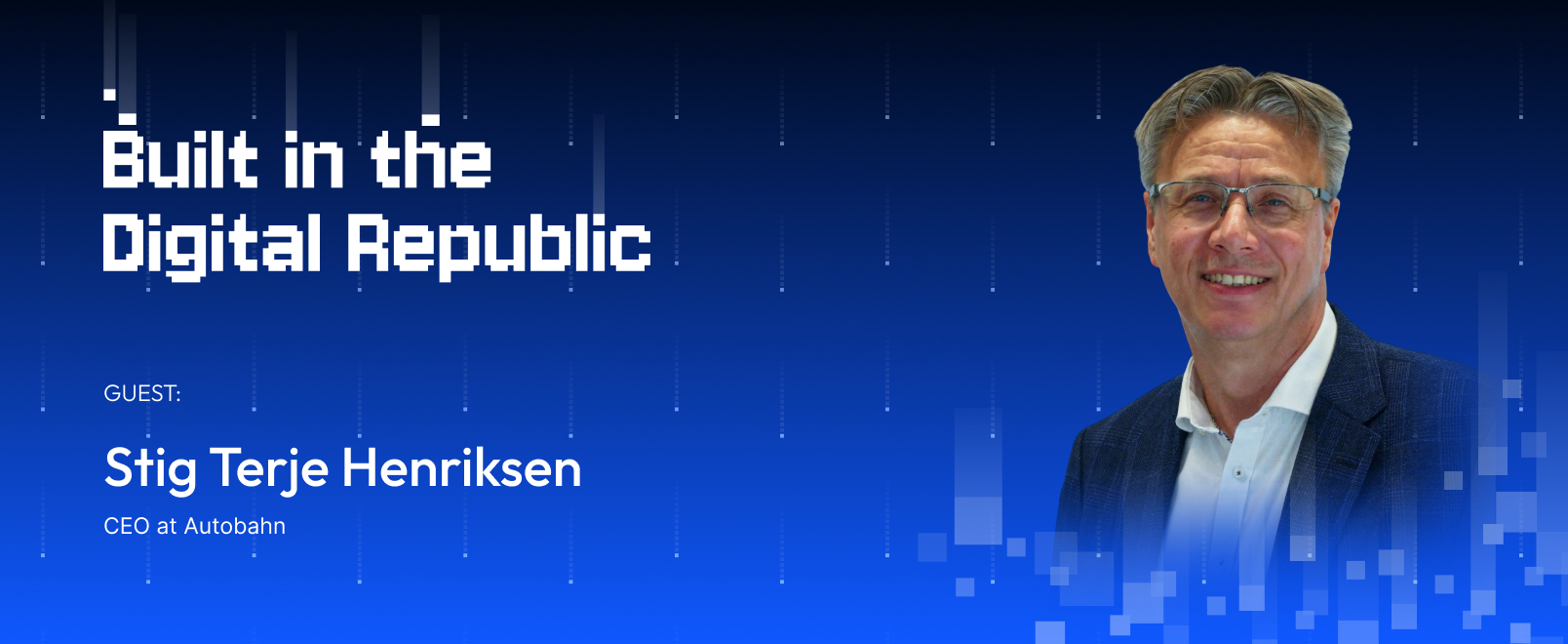
Today, I talk to Stig Terje Henriksen, who prefers to go by Terje. He arrived in Tallinn in 1996 from Denmark.
Years later, he sat on the Danish-Estonian Chamber of Commerce board. He sold a bookkeeping firm to Webhelp. And now he runs Autobahn, an Estonian automotive SaaS that works with Peugeot, Opel, Fiat, and Alfa Romeo.
Terje has seen every phase of this relationship. So, together, we travel back to 1996 to learn about Estonia’s nearshoring history.
I’m Alex Antonuk.
This is Built in the Digital Republic.
Let’s get started.
Terje, thanks for joining today. You have quite an experience to share. So let’s jump straight into it.
You arrived in Tallinn in 1996 from Denmark when ScanShipping opened its office there. At what point did Estonia stop being a temporary spot and become the place you’d built your career?
Stig Terje Henriksen:
— Alex, first of all, thank you very much for inviting me to this podcast. I’m honored to be a part of it. But yes, in June 1996, I was a young trainee at a Danish shipping company in Aarhus.
I was taken to the director’s office and told it was my turn to go abroad. And they wanted me to go to Tallinn to help open up a new office. There was a map on the table where my director was sitting.
And I was looking toward the U.S., trying to figure out exactly where I was going, because most of our young people were sent to the U.S.A. My director said, “Ah, it’s not over there, but it’s actually in Estonia.”
Hmm. Okay.
I came to Tallinn airport, and that was before it was renovated – this is today. I was thinking: “Oh my God, what is this?”
But then I was taken to the old town in Tallinn, where we had our hotel, and everything changed. I truly fell in love with the city pretty much at first glance. Two weeks became 30 years – and I’m still here.
So, exactly when I chose to build my career in Estonia permanently is very difficult to say, but I can say I was hooked from day one.
Alex Antonuk:
— Right. So you stayed. And in 2013, you founded a bookkeeping firm, specifically for Norwegian and Danish businesses, run out of Tallinn. What were Scandinavian clients actually buying – and why from Estonia?
Stig Terje Henriksen:
— Back at that time, accounting was based on very much manual work: typing in debit, credit, etc. And as you understand, labor cost is truly expensive, particularly in Denmark and Norway. When I founded my bookkeeping company, the idea was to offer a low-cost accounting service performed by skilled accountants, but working from Estonia.
It was very successful. I had different clients and several accountants working for me, but I was not the only one with that great idea. So rather quickly, big Scandinavian enterprises, such as Nordea Bank, DNB Bank, and Ramirent, came up with the same idea.
They established a shared service center here in the Baltics, meaning the hunt for skilled accountants who had an understanding of Danish, Norwegian, and Swedish accounting legislation made it hard to find one here – and expensive, as well. For that reason, I merged my company into Runway Group back in 2015 and merged my clients and accountants to Runway’s new BPO accounting pillar, which then later became Webhelp.
Alex Antonuk:
— That combination of price and reliability clearly worked, because that business of yours merged into Runway. And it eventually became part of Webhelp’s 1,200 nearshore operation. What services were Scandinavian companies outsourcing at scale?
Stig Terje Henriksen:
— Back again at that time, the core business that was outsourced from Scandinavia to Estonia was a customer support center, call center, both inbound and outbound calls. At Runway, which later became Webhelp, as mentioned, we were offering customer support for, particularly, Norwegian Air, different travel agencies, telecom companies, as well as consumer companies such as Electrolux, Samsung, and different other ones. The key was to offer services in the local Danish, Norwegian, and Swedish languages.
But as mentioned, big companies like the banks, insurance companies – such as IF Insurance – decided to place the shared service center here in Estonia, Latvia, and Lithuania. So again, quickly, the entire Baltic state was drained for Scandinavian-speaking agents, while we actually started to offer more sophisticated back office BPO services such as accounting, payment services, data entry, market survey, etc. All types of services that demanded a heavy labor input.
Basically, what we tried to do was move away from very language-specific tasks to more back office-specific tasks, in order to actually have a sufficient amount of resources available for different jobs.
Alex Antonuk:
— Interesting. When you sat across from a Danish or Norwegian buyer, what closed deals? Price, language, culture, time zone – what actually mattered?
Stig Terje Henriksen:
— Well, yes, here, of course, price was a key selling point when discussing with the customers in Denmark or Norway. But that’s not the only thing. For example, a Danish customer’s trust in you as a person and the company you represent is equally important.
This trust, you need to build it up, and this is only done based on a proof-of-concept. It’s fully understood that we make mistakes, but when we make mistakes, it’s expected that you are transparent. You are honest, and it’s one of the most important things.
Because if we’re that – and solution-oriented in solving the problems – then it will work out. If you try to hide something, if you put the fold of the problem on them instead of solving the problem in a proactive way, in such cases, the red thread of trust is broken, and you’re quickly out. So yes, building trust, I would say, is the key to success.
Alex Antonuk:
— So it’s trust. I agree with you, Terje. In my experience, it’s the crucial factor in any relationship.
Now, you’ve served on the Danish-Estonian Chamber of Commerce board for over twenty years. Given what you just said about trust and what else closes deals, has the type of Danish business looking at Estonia today actually changed?
Stig Terje Henriksen:
— Absolutely, it has changed. In the early years, we had many Danish SMEs that saw Estonia as a kind of new, easy market for them to sell their product and services, but they had doubts and were insecure about how to approach – and worried if their business in Estonia would be in safe hands. This doubt has changed.
Today, we have several Danish companies that are well-established doing business in Estonia, having local management doing very well. Examples: Velox, Vestas, Jysk, Pandora, all companies that are successful in doing their business in Estonia with a local Estonian team running it. That was a bit of a different setup in the early days.
And what I must say today, I think particularly IT and security related products and services is one of the most wanted businesses that Danish companies are looking towards in Estonia. Not to sell their Danish services to Estonia, but more to learn from Estonian local companies that have extremely good experience in those fields.
Alex Antonuk:
— And that brings us to the obvious competitor. Poland is always in the room for Scandinavian nearshoring. Honestly, when does a Norwegian or Danish company pick Estonia over Poland, and when does Poland win?
Stig Terje Henriksen:
— Yes, that’s of course a good question. As you say, Denmark is very close to Poland. So yes, it’s always been there, and it’s a huge competitor.
Anyway, Poland is a country with cheap labor costs. Today, way cheaper than Estonia for blue-collar labor, and customer service agents on top. They have a much bigger labor force than in Estonia. I think there are 38 million people living in Poland, if I’m correct, compared to 1.3 million people living in Estonia. So, when price is important, then Poland often becomes the first pick. But when the service you’re looking for becomes more sophisticated, such as IT development, financial, complicated services, then quality and stability, and again, trust, become more important than price – and then Estonia often wins over Poland.
Alex Antonuk:
— You just mentioned Estonia’s advantages. Now, let’s look at an example from your own career. In 2018, Webhelp acquired Runway. When a global BPO buys an Estonian nearshore operation, what do they value about the Estonian setup, and what do they immediately try to change?
Stig Terje Henriksen:
— At that time, Runway had some 900 people in our BPO centers across the Baltics, Ukraine, and Spain, all having special Scandinavian knowledge – that’d be the language, accounting, etc. We were in charge of the entire back office for Norwegian Air. We had a special department in Riga that did the daily price calculation for the airline tickets.
We trained and managed the aircrew’s work schedule. So, this entire setup was one of the key selling points that Webhelp was very interested in taking over. They did not try to change anything about that setup.
In fact, we kept it going pretty much the status quo. But with the strength of a global company coming behind us, it opened the door to many business areas for us, such as opening a business for TikTok, where we established a center in Daugavpils, Latvia, for 250 content moderators for the Russian market. We opened a business with a top Denmark insurance company.
That was our win, that we got out of it, coming into a much bigger organization. Webhelp was, at that time, I think, around 50,000 people. Today, they have grown to 250,000, actually.
But yes, to become a part of something bigger gave us a completely different organization that was much stronger to increase and scale our business tremendously. What they got from us was a core setup, which was very much Scandinavian-minded.
Alex Antonuk:
— Okay, that sounds impressive. So, you saw the corporate machinery up close. You left the BPO world in 2022 when you joined Autobahn, an automotive SaaS.
Was that a personal pivot away from something you no longer believed in, or were you seeing a larger trend about where the nearshore model was heading?
Stig Terje Henriksen:
— I’ve been in the corporate business world pretty much through my entire career. What I wanted was to get a taste of the blooming startup ecosystem in Estonia. There was a lot of talk about it and a lot of news about it. It was very attractive. This was very attractive to me, and something new. When Autobahn offered me a job, well, I just couldn’t say no.
Alex Antonuk:
— Can’t help but agree with you, Estonia is a startup marvel with inspiring success stories. Now, Autobahn sells its system to OEMs and importers across Central Europe – but not into Scandinavia. Is the Scandinavian automotive market different, or IS it more about buyers’ perception?
Stig Terje Henriksen:
— Well, Scandinavian countries very much use old legacy systems, or they have developed their own system by some local provider. This is a system they used for many, many years. Meaning if Autobahn ought to sell our system in Scandinavia, we’re basically replacing an existing system.
Selling the core sales system of the importer and the dealer is a very complex decision, very strategic decision to take, and time-consuming to make such a decision. For that reason, we’ve been concentrating on the Eastern European countries, where decision-taking traditionally is much faster, and that has been our success.
Alex Antonuk:
— Yet, despite that Scandinavian gap, you cracked Stellantis, one of the largest automotive groups in the world. How does a 14-year-old Estonian company of modest size end up with its procurement?
Stig Terje Henriksen:
— Well, Peugeot was pretty much our first customer, and they came to us several years ago. They were using an old system, meaning they had to navigate their sales through several different platforms. We offered one seamless platform for the entire sales journey of new car sales, and that was the trigger.
That was what triggered Peugeot to start working with us. Since then, together with Peugeot, we’ve been developing, we’ve been improving, and adding many new features to our vehicle sales platform, making our product rather unique on the market. So long story short, it was a mutual win for both parties to create something together.
The risk was taken, yes, but today’s result has proven itself.
Alex Antonuk:
— Talking about local presence, Estonia’s nearshoring story works because much can be done remotely from Tallinn. Autobahn doesn’t work that way. You opened offices in Warsaw, Prague, and Zagreb instead of selling remotely. Why did you decide to go local?
Stig Terje Henriksen:
— Well, our vehicle sales platform is a crucial part of the entire ecosystem for new car sales. It pretty much connects the entire sales journey into one. To our customer, it’s a strategy, well, for true, a solution they’ve chosen.
And when first chosen, it’s extremely difficult to change to the new system. Not difficult, but risky, and very time-consuming.
In Scandinavia, our target customer, there are well-established importers with years of history. And for years, they’ve been using their own system, often developed by locals or using one of the more global competitors of ours. To enter the Scandinavian market is not a question about offering something new, but a question about replacing an existing system that they’ve been using for years. Regardless of whether they’re satisfied with the existing system or not.
It’s a big decision to replace, as it involves a big risk that can directly influence their day-to-day sales. In the Eastern European market, the importers are newer companies. They are not big old importers like the ones in Scandinavia.
They are much more open towards taking risks in order to win with a better sales system than the existing one they’re using today. Why?
The sales journey is much, much shorter than if aiming for the big Scandinavian ones. That’s why we strategically have positioned ourselves with a strong sales team in Warsaw, Prague, and Zagreb.
Alex Antonuk:
— That makes sense. And it’s definitely hard to overstate the value of culture and mentality.
To finish our conversation, Estonia produced Skype, Wise, Bolt, and Pipedrive, top-tier engineering coming out of a country of 1.3 million people. You started in BPO, now you’re running a SaaS company yourself. The country has clearly changed over the past decades. From where you sit, what’s the real potential today for Estonia to sell tech or engineering services to Scandinavia? And is anyone actually capturing it?
Stig Terje Henriksen:
— Well, it’s no secret that the Estonian tech journey started with Skype in the early 2000s. It was the foundation leading to unicorns mentioned by you. The success stories kept coming, one after the other, and the Estonian startup environment was not only inspired by those unicorns but also supported.
On top of that, the Estonian state has been very supportive in branding this unique tech ecosystem we have, and they’ve been branding it worldwide. This means today, if you’re asking anyone all over the world with an interest and little understanding, then immediately, Estonia pops up as a unique place where things are happening, and it’s happening fast. This reputation is the ground for Estonian tech companies spreading their products and services.
Because when, for example, approaching Denmark, selling a deep tech solution or a SaaS product, then they’ve already admired just the fact of being originated from Estonia. Being an Estonian tech company is a blue stamp, and that blue stamp is the first step in creating the trust that is so important in order to work with Scandinavian companies. So yes, Estonia has reached a long way since I arrived back in 1996, and today we’re only seeing the start of the journey in exporting our tech companies, products, and services in Scandinavia, for that matter, throughout the whole world.
Alex Antonuk:
— Stig Terje Henriksen, CEO of Autobahn. Thank you very much for this conversation.
Stig Terje Henriksen:
— Thank you. It’s been a pleasure being here.