

Alex Antonuk:
— Imagine it’s Tuesday morning in Texas. A plumbing company has six vans out on jobs, and one of them is running hot under the hood. No smoke yet, nothing on the dashboard. So the driver has no idea.
Any other week, that van would end up on a tow truck, losing a full day of work. But this time, the fleet owner gets an alert and calls the driver. The driver pulls into a shop, and by lunch, he’s back on the road.
For years, that kind of warning required expensive hardware and installers a small business simply couldn’t afford.
That’s where Drivestream comes in. Developed by Catrak Technologies, the product started with a basic tier to make GPS tracking simple and accessible. But to scale Drivestream into an intelligent operating system for fleets, Catrak found partners in Estonia.
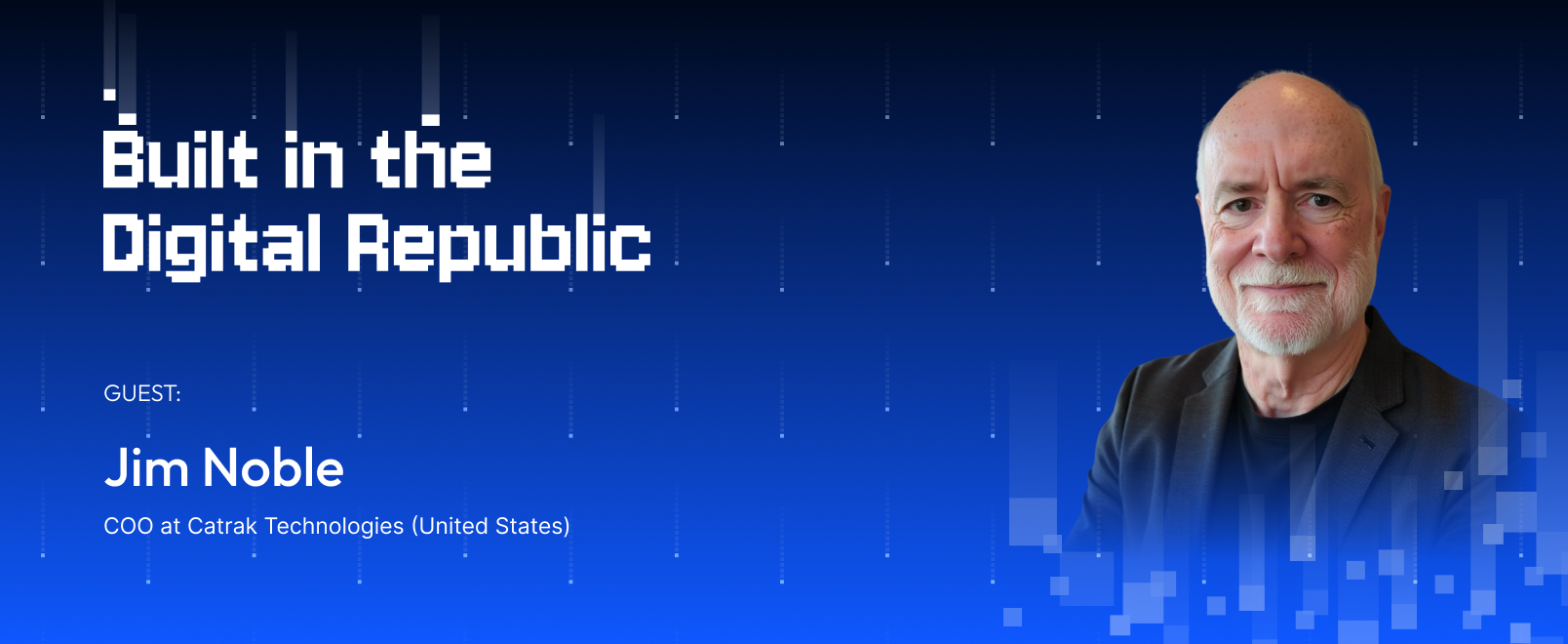
My guest today is Jim Noble, Chief Operating Officer at Catrak Technologies. Catrak was founded in 2021 in San Diego, California, starting out in fleet security hardware. Later, that device laid the groundwork for a growing portfolio of GPS and telematics tools.
In this episode, we discuss the company’s most prominent solution, Drivestream, and the transatlantic partnership driving its growth.
Jim, thanks for joining.
Jim Noble:
— Well, it’s a pleasure to be here, Alex.
Alex Antonuk:
— Tell our listeners a bit about your history as a company. I know that Catrak started with a catalytic converter alarm, hardware that catches a thief red-handed. And Drivestream is where the story forks from hardware to software. How did you build upon a security gadget to create a tracking app that a small business can sign up for?
Jim Noble:
— It’s a very interesting story, Alex, and one that really points to Catrak’s ability to listen to our customers.
When we started to build the catalytic converter anti-theft device – still the only IoT-based anti-theft device on the market – part of that build included a little telematics device, so that we knew where the catalytic converter was and, when it was stolen, where it was going. That gave us a bit of track and trace to start with.
Then our customers started coming to us and saying, “This is really interesting, but all I really want to know is, where is my vehicle today? How long has it been there? Is it where it’s supposed to be?” So that started us thinking about the tracking and tracing of drivers.
But we were still device-laden to be able to do that. So it led us to thinking about doing it with a smartphone only. It’s a very powerful computer, it’s got all kinds of tracking mechanisms in it already, and everybody has one in their pocket.
So we really started going in that direction. But again, listening to our customers, there were many requests that said, “We’d also like to be able to verify our employees’ time cards. We’d also like to know when they get somewhere, how long they’re there and when they leave,” which requires geofencing.
All of these things, Alex, led us into what was the base product for Drivestream. And again, continuing to listen to our customers, now we have, as you mentioned in your intro, the request to understand what’s going on in the vehicle from a fault standpoint and from a maintenance standpoint.
That led us into understanding what’s going on in the vehicle from emissions and carbon output, and the types of things that really are necessary in order to completely understand and completely manage your business.
So it was a very organic process of just listening to our customers and understanding what their needs were. That’s how we got to where we are with Drivestream today: from a very simple solution to a very robust, complete fleet management solution, and everything in between.
Alex Antonuk:
— So visibility was the whole reason Drivestream exists in the first place. The market has plenty of simple GPS trackers that just put dots on a map. What does Drivestream solve that traditional tracking tools miss entirely? And what does the future look like for Drivestream from your perspective?
Jim Noble:
— I’m going to tackle the second part of that question later on, because what the future holds for Drivestream is a long answer.
As far as track and trace goes, we do two things differently. Number one, we are trying to understand the driver from a time management standpoint. It’s not only dots on the map, it’s a time manager.
So whether it’s trip history or driver history, understanding where they were and how long they were there, and really being able to use that to resolve any conflicts with the customer about when the employee arrived. Because most of these people aren’t drivers, they are vocational workers. They’re plumbers and electricians and construction workers and landscapers. They drive as part of their business, but they are something else.
So when there’s a dispute about when that person arrived at the job and how long they were there, we can go back and verify the time that the employee was there, and we can very easily resolve those disputes. And we’re also able to communicate with the driver to say, “Hey, we’ve added one more stop for you today.”
So it’s very operational, but very simple to use for the vocational business owner, the small fleet owner, whatever it may be.
The second thing we did, after we spent over a million dollars developing it, is we give that portion of the product away at no cost. So there’s no barrier to entry for the small business owner that has four, five, ten vehicles.
There’s no installation. You just download the app on your phone, do a little bit of setup work on the business office computer, and you’re off and running. And again: no cost, no contracts, no obligations. It’s very unique in that aspect, and it’s been very popular for us.
As far as the future of Drivestream, if you look at our roadmap over the next 12 to 18 months, you’ll see that we are on a very fast release cycle to become a complete fleet management app.
I alluded to this in the answer to the first question, Alex. We are now doing driver safety. We’ve partnered with the preeminent scoring company in the world, FICO, in order to do very detailed, high-fidelity driver scoring.
We’re now offering vehicle health, which is early detection of things that are going on in the vehicle, reporting it back both to the driver and to the business owner, and bringing up solutions on what we need to do about that and prioritizing how it needs to be done. Is this something you can continue to drive with until the part comes in and then take it in for maintenance? Or is it get it to the shop or get it on the tow truck immediately?
I also talked about the fact that we’re doing distance per gallon, whether it’s miles or kilometers per gallon, and how that vehicle is matching up against the fleet average, what the driver can do to improve their mileage, and then that ties in with carbon output.
We’re also going into field services, which is being able to actively manage the driver while they’re in the field: add appointments, subtract appointments, communicate directly with the employee while they’re on the job site. They’ll be able to manage the inventory off their truck through the Drivestream app.
So it’s really everything from where is my vehicle, to how is my driver driving, to how is my vehicle behaving, to how do I manage my business, and everything in between. The future for Drivestream has really just begun.
Alex Antonuk:
— That’s a real jump from a location pin to a system making calls for you! But for a small fleet owner who’s never used telematics before, all of this can sound like a lot. What can someone actually try for free today in your app?
Jim Noble:
— Exactly what we were just talking about with track and trace. It’s what I call track and trace on steroids. I know where my vehicle is, I know when they got there, I know how long they were there, I know the hours that my employee worked, and I can verify that against anything else I have to do with payroll.
So there’s a number of things, but it’s very simple to use, no cost, no contracts, as I said before.
For the small fleet owner, normally they’re not apt to go to a very sophisticated telematics system in order to help them manage their business. So what we’ve designed with Drivestream is a customer journey.
They can start very simply. Again: where is my vehicle? What kind of hours are my people working? And then they can step up to driver safety and driver behavior, and understanding driver behavior, and using that, by the way, in their conversations with their insurance carriers.
And then taking the next step of the journey: understanding my vehicle, the lifecycle of my vehicle, the maintenance cycles of my vehicle. So it’s all a journey for the small fleet owner. We make it very easy to use to begin with, and then they can branch out as they see their needs growing.
Alex Antonuk:
— If I were a fleet owner, I’d totally give Drivestream a try after this description.
Jim Noble:
— I’m going to quote you on that and take it out into our advertising.
Alex Antonuk:
— Now let’s talk about how the product took its shape. To work on this platform, you searched globally for high-end technical skills. What specific engineering capabilities did you need, and why was this Estonian team the right match?
Jim Noble:
— Because we’re really embedded in the mobility space and understanding how vehicles operate and where they’re operating, what we were really looking for in an engineering team was somebody who had a thorough knowledge of vehicles, of the mobility space, of driver behaviors.
We looked at quite a few firms. As a matter of fact, we were engaged with another engineering team early on that didn’t quite understand what they needed to do. We were trying to teach them everything about vehicles and mobility.
So when we settled on the current engineering team in Estonia (Bamboo Apps), it just all came together. They understood the mobility space, they understood vehicles, they understood OEMs, they understood drivers. It was a very easy transition to get them up and running and start moving the product forward.
Alex Antonuk:
— I totally understand you, Jim. Based on my own experience with software projects, having specific expertise is a must for successful delivery. But you found this kind of expertise on the other side of the globe, which actually leads me to my next question. They say US startups know how to move fast and capture market share, while European engineering brings deep architectural discipline and rock-solid code. How does it give Drivestream an advantage over local US rivals?
Jim Noble:
— I think the question is really the answer, which is: we don’t have to go back and revisit code. There’s not a lot of broken code. We can move fast because the team understands what needs to be done, and how to do it quickly.
So whether it’s app building, whether it’s a clean look and feel in the UI, or whether it’s pretty complex code in the background to be able to read sensors out of vehicles, understand what they’re saying and prioritize that – that gives us a big advantage over using a team that maybe isn’t as thorough as our Estonian engineering team, that maybe isn’t as understanding of the precision that we need.
Because you only have one chance to get it wrong for a customer, and then they don’t believe in what you’re doing. You need to get it right the first time.
The other thing is that the Estonian team is very dedicated to what we’re trying to do, and they’re very invested in our partnership. There’s a work ethic that we get out of the Estonian team that we really enjoy, and that really helps us move fast.
Normally I have a sign behind me that says, “Be fast, but be right.” And that’s normally what I get out of the team.
Alex Antonuk:
— What you say is important indeed. In the end, your development team sits in Tallinn, but your users drive trucks across the Americas. How do you close that gap, so engineers a thousand miles away actually feel the daily headaches of a US fleet manager?
Jim Noble:
— That’s an interesting question, Alex. I think there’s a two-part answer.
The first part is, I’m always amazed at the Estonian team and how well they understand what we’re trying to solve for, and what the pain points of the user in the US and North American market are. But that goes back to one of the reasons why we chose the team to begin with, because there was a base core understanding.
The second part of the answer is, we’re still learning how to best communicate what the need is. What’s the end result that we’re trying to solve for with the feature that we’re working on?
To be quite honest with you, that was a bigger learning curve on our side, in the US, than it was on the Estonian side. They would always take our requirements and do their best, but we didn’t always do the best job of telling them the story of what that feature needed to be.
So that’s one of the growing pains on the Catrak side that we had to get better at: being able to tell that story, being able to make sure that the engineers understood what we were trying to do. It’s very interesting, and it continues to grow.
Alex Antonuk:
— Agreed. Well-executed onboarding and constant communication always make sense, from business to team. So now that the partnership already runs through Estonia, does a global launch ever come up in your planning, or does the US stay the whole focus for now?
Jim Noble:
— I actually have to say that that’s one of the things the Estonian team has changed our perspective on. In the beginning days, we had only ever pictured being a North American solution: US, Canada, Mexico.
But the more we work with the Estonian team and their leadership, and the more we understand the global opportunities, yes – a global expansion is now squarely in our vision, and we want to get to it as soon as possible.
I’ve been involved in several products that have grown from a US base to a global base, and it used to be much harder than it is today. With the technology that we have, translations and visuals and those types of things all become a little bit easier than they used to be. So it makes a small firm like ours much more willing to get involved in global expansion.
And, of course, with the contacts that the team has, that makes the expansion ideas even easier at that point. So yes, we have some big visions now for the future that we didn’t have before.
Alex Antonuk:
— Well, Jim, I sincerely hope there is much more coming for Drivestream in terms of global reach. Back to the features. Catrak proved you can build smart physical devices, but an intelligent fleet OS has to interpret their data and turn it into decisions. How are you solving this together with the R&D team?
Jim Noble:
— That is a great question, because we did, in the beginning, build physical devices with a little bit of software in the background.
But again, going back to the selection of the team, one of the things that really helps us is the ability for the engineering team and the UI team to say, “Okay, this is how we build the software to do what you want to do.” That was not in our original expertise, but now, because the team is so much a part of the Catrak organization, we consider it a core capability of ours.
As you know, software and hardware are two very different things to get involved with. It was a transition for us to understand the nuances of hardware and coding, and how to get that out so that there were no bugs involved and it was a great user experience.
So again, I’ll go back to the fact that selecting this team has really helped us make the transition between hardware builders and software developers.
Alex Antonuk:
— Thanks for the detailed explanation. Which advanced Drivestream capability was not part of the original brief, but emerged through the engineering process itself? Is there any role of the partner?
Jim Noble:
— That is a very interesting question. I will answer it this way, Alex: almost every feature that we’ve dreamed of, that we’ve built requirements for and sent over, has become enhanced by the team. Almost every one of them.
One of the things that we do on a regular basis is hold ideation sessions, where we just think through ideas. We originally did that internally as a team at Catrak, and then we branched out and brought in the team members to help us with that, and it has really helped.
Every time we came up with what I call a blue-sky idea – something that we think should work – through these ideation sessions we very quickly get to: is it possible? Is it not possible? How heavy of a lift is it? And then, almost inevitably, it’ll become a better idea once it goes through the team and they put their engineering slant to it, their experience, what they’ve built before, and what they can bring to it.
And that’s just the beginning of it. We’re incorporating a whole product set inside of Drivestream that helps drivers with augmented reality and AI, that we never even dreamed of, that came completely from the team.
As we go out to our customers and prospective customers and talk about that product enhancement, everybody is so enthusiastic about what we can deliver. And again, that didn’t come from us at all, that came completely from the Estonian team.
So it’s been a fantastic collaboration. And we get better at collaborating the longer we work together, because we understand what each other’s motivations are.
Alex Antonuk:
— I agree with you. This sounds like an innovative feature that can propel Drivestream to a truly comprehensive fleet OS. But features aside, let’s look at the business side of the partnership. Behind Catrak and Drivestream is a leadership team with decades of deep domain expertise in the US market. Looking at this partnership from the inside out, what would you advise Estonian teams who want to build products for North America? What needs to change in their processes, product design, or business culture to truly hit the mark in the US?
Jim Noble:
— The difficulty is always, as we talked about before: does the Estonian team understand the problems that we’re trying to solve for?
My advice really is to become domain experts in a field, in a category. That may not be vehicles, it may be something else. But it’s very important that you understand the pain points of the customers that you’re building for.
That can be done in a number of different ways, but normally it comes through the experience of working on various projects and understanding what the team is good at. Some teams are great at building out code and deep software projects; other teams are good at exactly what this team is good at, which is understanding a segment of business and being able to build products around it.
The other thing that this team does very well is that they’re very accommodating to time differences. We’re recording this podcast where it’s early in the morning for me, and not as early in the day for you, and you bring the enthusiasm of someone who is tackling this in the morning rather than late in the afternoon.
We really appreciate that, especially since most of our team is located on the West Coast of the US, which makes the time difference even bigger. So being accommodating to that time has been incredible for us. Many times we’re early in our morning, you’re late in your day, and I get the same enthusiasm as if you were working early in the morning. We really appreciate that, and I know it’s not easy to do, because I’ve worked globally for a long time.
So I would say: understand the domain, understand the time difference, and really be able to communicate on a regular basis. We’re in such deep communication with the engineering team – we converse back and forth via Slack, multiple conference calls a week. We’re in constant communication, and I think that’s one of the big keys.
If I was going to counsel the Estonian teams, it is: how do you communicate as if you were sitting in the office next door?
Alex Antonuk:
— Thanks for this detailed information and your experience, it helps a lot. Looking at the flip side of the equation, to wrap things up: why do you think American fleet business plus European engineering could be a winning formula for building a market leader?
Jim Noble:
— That is a great question. I’ve always had great respect for European teams and the way they handle European business, and the way they handle what in the insurance business we would call the motor side of it.
Their focus on safety, their focus on maintenance, their focus on the specs of vehicles, how long workers work – all those types of things often are more precise than they are here in the US.
So having the Estonian team and the US team work together brings some of that precision into our products. We’re influenced very heavily by the viewpoint of the engineering team on how they think things need to be done to really run a business well around vehicle management.
That translates into the Drivestream product: how we look at faults in the vehicle, how we’re looking at driver safety, how we’re looking at emissions and carbon. The emissions and carbon are heavily influenced by European standards.
So that certainly has translated into Drivestream and what we’re doing, and how we’re bringing that product to market in the US. And, of course, as we go back and talk about our global expansion, that only makes us more well-rounded when we start to expand into other parts of the world.
Alex Antonuk:
— I hear you, Jim, and agree with this take. Building your product on a global foundation, even if it will be available locally first, gives you a competitive edge from the very beginning.
Jim Noble, COO at Catrak Technologies, thank you for this insightful conversation.
Jim Noble:
— Thank you very much, Alex. It was a pleasure to be here today, and it’s great to work with you and the team.