

Alex Antonuk:
— Twenty years ago, Estonia invented the digital nation label. You’ve heard all about X-Road, Digital ID, and e-Residency.
The world took notes.
Now governments show up with different questions. Rather than “how do you make things work faster?”, they ask:
- “What happens when someone attacks the digital infrastructure?”
- “Who do you trust when you cannot see the servers?”
- “Can AI run a country without breaking it?”.
Estonia’s story changed. First, efficiency became resilience. Then, resilience demanded trust. And now, AI enters a system already built for speed.
Today, I talk with someone who watches this evolution through the eyes of every delegation that walks the streets of Tallinn.
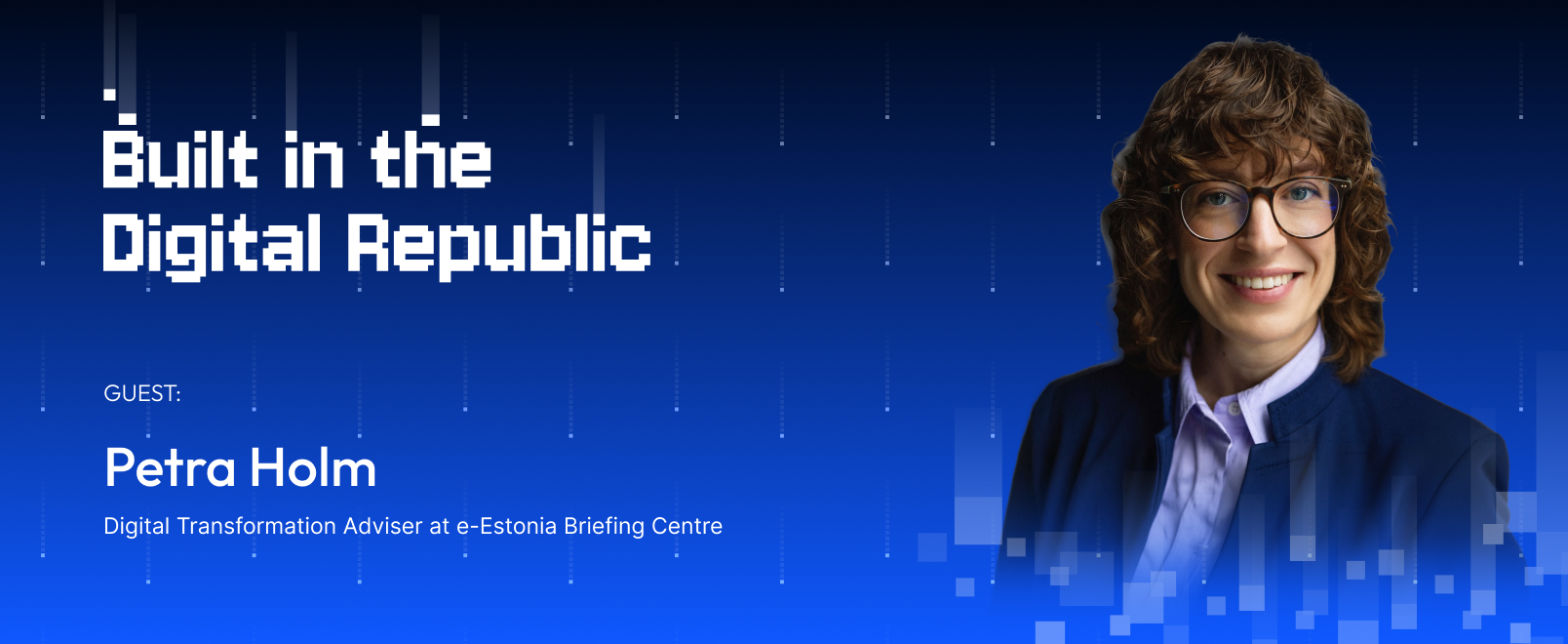
Petra Holm advises governments, agencies, and curious skeptics at the e-Estonia Briefing Centre. She sees what people fear and what they desperately want to copy.
The question is – WHAT actually transfers?
Petra, it’s nice to have you here today.
Could you start by telling us about your role at the e-Estonia Briefing Centre – what the centre does and who typically walks through your door?
Petra Holm:
— Hello, yes, thank you for having me. It’s a pleasure. Usually, we do these sorts of podcasts, so it’s nice to be a guest of someone who is interested in the Estonian digital story.
I am a digital transformation adviser at the e-Estonia Briefing Centre. My job is to deliver the story of Estonian digital transformation. So, I’m more of a storyteller.
I do not participate in the building or the improvement of the digital state per se, but the Briefing Centre serves as a knowledge hub. We stay on top of all of the new things that are happening, and we deliver them to the people who walk through our door. And they are all walks of life.
So, it could be the public sector, the private sector, or academia. We get MBA students, ministers, presidents sometimes, and company owners. They’re all here to learn from the Estonian experience to see what can inspire them, what can be copied.
It’s never really a copy-paste solution, but there’s a lot of inspiration to be drawn from the Estonian experience.
Alex Antonuk:
— So, you literally get everyone, from tax officials to justice ministers. That must create patterns. When you first started this work, what did visitors mainly come to learn – and what do they ask about now?
Petra Holm:
— Well, I started this job almost two years ago. The patterns were rather obvious very quickly. And it actually depends not on the sector from which the people come – public sector, private sector, or students.
It very often depends on the country or the region where these people come from. But you can still see patterns.
For example, people are very often concerned not about the technology per se, because actually that is the easy part. Technology is something that truly can be copied to a large extent. But they’re worried about the people or the change in the management part, the human part of digital transformation; about trust, how to get the people on board, how to overcome resistance, and how to sell the idea of the necessity of digital transformation.
That is very common in pretty much every group that comes here. The Germans, for example, are one of the biggest groups, historically have always been the biggest group of delegates who come to Estonia. And they are very, very concerned about privacy.
The French are very much concerned about trust. Some people are simply sceptical. But as soon as they come here and listen to the extent of Estonian digital transformation, even delegates from countries that are digitally advanced, like Denmark or the Netherlands, see some things that we’ve done differently that could benefit their countries as well.
And so very often we hear sighs about people wishing that they also had a similar approach to digitalization.
Alex Antonuk:
— Okay, I hear several things in that answer. So first, yeah, some people still come for technology, but that’s not the main part of the story. They still leave worried about something else, usually trust or exclusion.
You touched on scepticism. Which misconceptions about Estonia’s digital model do you correct most often?
Petra Holm:
— That’s a very good question. I think we very often have to explain that it is possible to digitalize a country and still preserve privacy. Very often there is a fear that as soon as something is, so to speak, online, or digital, then it becomes less safe, that it is prone to being lost, that people’s privacy have to be compromised.
Very often, we have to explain what measures Estonia took, and how we protect privacy, how we’ve built this digital society to give people more power, more control over their data, and how transparent the services are, how difficult it actually is in Estonia with our approach to abuse power, or abuse access to data, even if a person, technically speaking, is in the position to have access to certain databases. We have to explain that this fear is not unbased, it is based on the experience that people from other countries have. But in Estonia, we’ve been able to address that with the checks and balances that we have in place.
Alex Antonuk:
— That’s something to think about. Actually, l know that in one of your interviews for the AUA Focus Series, you noted that Estonia still provides offline services, but most people choose digital, because “not standing in line” is a better life. Yet, many delegations fear digital exclusion. And the question is, what specific metric or story do you show them to prove that digital-first doesn’t mean human-last?
Petra Holm:
— Yeah, digital exclusion is a very big topic. This is what I mentioned in the beginning, you know, how do you get the people on board? Well, there are many unique features of the Estonian digital society.
But one of them is that we’ve actually always focused on the people. Because we started with a digitally illiterate country. It is unsurprising that we had a massive challenge of educating everyone, the entire million people, basically, on how to use computers.
And as soon as we started in the 1990s, we just kept going, we just continued educating the people. We’ve provided free computer courses for everyone, not just the children in schools, but the adults, the elderly, everyone was able to participate in these courses, even many times, if they’d like. We still provide these courses. The types of things that we teach have changed over time. We no longer have to focus so much on training people on how to use digital identity or how to log in.
Most people know how to do that. And they feel safe doing it because it’s super easy. We’ve designed it so that everyone can log in.
And even if they struggle – because of limited access to the internet, maybe they don’t have a personal computer because they cannot afford it, or any other reason – we have a culture of helping one another with digital issues. For example, libraries serve as a point of entry for a lot of people.
Even a person with very limited digital skills can come to a library. Everyone in Estonia has an ID card and the ability to log in. But the librarian may help you do that because they’re trained to do that.
Currently, we are training librarians to start teaching people how to use artificial intelligence because this is the next wave, I suppose, or the next big leap that we’re taking in pushing our digital society forward. It’s artificial intelligence. And again, we’re focusing on the people.
We have to teach them about the safe use of technologies because people don’t automatically know these things. So we’ve done this historically. And it looks like we continue to do this.
The year is 2026. We’re launching artificial intelligence in schools, in our public sector, increasingly, very carefully, but still increasingly, that’s the path forward. Again, we start focusing on the people. We have a goal of educating 100,000 people in the next year or so, if I’m not mistaken, Eesti.ai, the latest initiative that the Prime Minister announced. It’s a whole-of-society approach. And we focus on education, so that minimizes the risk that people don’t have the ability or any understanding of how to use digital services. We want to avoid a situation where people cannot use digital services.
We are very understanding of the people who do not want to use digital services. It is a democracy after all, so people should have a choice.
And even though outside of cities or bigger towns, there may be limited access to services, just as always, people in the countryside are disadvantaged in that sense. You always have to travel longer to access services or meet a civil servant; that is a challenge. But that doesn’t necessarily have to do only with digitalization – that is just societal trends, people moving to the capital, moving to bigger city centres, and the elderly staying behind in the countryside. So yeah, that is an issue.
But I think from what I understand, it’s an issue pretty much everywhere and doesn’t necessarily have to do with digitalization only.
Alex Antonuk:
— Okay, great insights, Petra.
As I understand, resilience and continuity have become much bigger themes in your conversations with visitors. What does that look like in practice? What are organizations most worried about?
Petra Holm:
— Digital sovereignty is a very big phrase these days for geopolitical reasons. It’s become really quite interesting in the world lately. And Estonia has been lucky in a sense because of our geographical location.
We’ve always had to think about resilience and cybersecurity, and digital sovereignty, before it even became a buzzword. We’ve always thought about how to secure our systems. We know that there is no such thing as a safe database or server.
Everything can be hacked with enough motivation. So we always minimize the risk that any attack can have on our systems. In terms of digital sovereignty, it turns out that when your servers, which in the case of Estonia are located mostly in Estonia, are sovereign, you’re forced to build digital infrastructure around the technology that’s available to you.
Turns out that this is the main concept of digital sovereignty, not depending on foreign computing or servers outside the territory. A lucky coincidence, I suppose, but we chose the right path. Now, increasingly, countries realize that this setup, the X-Road, for example, allows us to own our own data, to have control over it, and is the right approach.
But we also pioneered a concept like the Data Embassy. The Data Embassy, already in 2017, we were able to start storing copies of our most precious or most important databases outside of Estonian territory to prepare for the risk that our physical territory might be compromised for whatever reason. This allows us continuity.
Even if something extreme happens to us and everything else fails locally, we can still provide services to our citizens because the databases have been preserved. We’ve tried these approaches, and we’ve proven that they all contribute to digital resilience. And we’ve advised many countries to do the same, but officially, Estonia, to my knowledge, is the only country with a Data Embassy.
Everyone else is being quiet about it, which is a very clever approach.
Alex Antonuk:
— Yeah, so it’s impressive. That’s a lot to learn from Estonia, especially from this case you described. You know, those fears sound familiar to many guests I’ve talked to.
But let’s move to AI. You hosted delegations from all over the world. When you mentioned AI in government, not as a future concept, but as something Estonia is actively implementing, what is the very first question they ask you?
Petra Holm:
— Well, sometimes we don’t even wait for them to ask the question. The best way to address the question is to preemptively start talking about it.
Of course, we mention AI pretty much on the second slide that I show the delegations, so that if they are interested, they can ask about it. And very often lately, I’ve noticed that there isn’t that much interest towards AI, not in the sense that I noticed, let’s say, a year ago, or half a year ago. There is no excitement about it.
Everyone is sort of, yeah, okay, of course you’re using AI, it makes sense. And I guess the expectation is that we’re going to be careful with it, which is, of course, what I mentioned, as well, we’re not rushing into it. We don’t let AI govern our country, not just yet.
Before you can do anything like that, a country like Estonia with decades of experience that we have in digitalization, we know how much work goes into cleaning your data and so much preparation.
The future is agentic, the way we understand it in Estonia. And we need to find a way to regulate agents, make this transparent, traceable, and accountable.
We’re working on it as we speak. How long is it going to take? Not quite clear to me – at least, probably a year or two, maybe a little bit longer.
But because more efficiency is to be gained from implementing artificial intelligence in the public sector, as well as the private sector, it makes sense to think about it, to prepare for it, and design the system so that it can actually benefit from artificial intelligence. The concern is very often that it is unsustainable, that it is not sovereign. And of course, Estonia doesn’t have sovereign AI; we don’t have an LLM.
We’re using American technologies in that sense. Maybe something will change. But for now, we are preparing for a future where bureaucracy can be reduced further, and more tasks can be automated through the clever use and careful use of agents.
Now, of course, we need to strike a very fine balance between privacy and personalization. People should still have control over their data. So this is not very easy to design. We have been working on our Bürokratt.
It sounds funny in Estonian; it just sounds weird. When I say that in English, it sounds like a bureaucrat, but it’s our network of chatbots. This is what they look like, but they’re much more than that.
We are working on an additional layer that would allow these agents to communicate with one another and further connect these chatbots. We’ve been working on it since 2019. And I’m sure that the people who are actually the technical staff, because I’m not, I find it quite hard to understand how precisely artificial intelligence works, but I trust the people, especially in Estonia, who have put their minds and their best efforts to make this technology actually beneficial for our society and safe for the people.
This is the goal.
Alex Antonuk:
— You mentioned that AI in the slides is not impressive anymore. That’s why everyone just reads these and understands you’re using AI.
But if we’re talking about the practical application of AI technology, where exactly is Estonia experimenting with AI in government today? Maybe you have some use cases already in place, or some things that will be launched. Can you share an example that is not abstract, but actually touches citizens right now?
Petra Holm:
— Sure. There are almost 200 different use cases of AI in our public sector. AI does a lot of computation, works with a lot of data, builds models so that we can predict the behavior of our animals, or I mean, not predict the behaviour of animals, but make calculations about the weather, the climate, and many useful things.
They’re not obvious to the citizens, and you’re looking for an example that can directly benefit the citizens already. And that, I think, would be the Bürokratt thing, that chatbot is increasingly appearing on the web pages of public institutions, where you can engage in a conversation with a chatbot. Now, the cool thing about this chatbot, in my opinion, is that it speaks proper Estonian, which is very nice.
Not very many people around the world actually speak Estonian, and this thing does. It communicates in good Estonian with you, and you can talk about things that are actually not related to the public authority that you’re engaging with currently. Let’s say, because it’s a network of chatbots, it only answers based on the sort of controlled and correct information.
It uses RAG to make sure that it doesn’t hallucinate, it doesn’t lie to you, but it can query these databases of information that exist on the other platform. You could be talking about a warranty issue. Let’s say you bought a bicycle and it broke within two months or so, and a person doesn’t always know which public authority or which law applies to this problem.
You understand that it’s probably not normal that your bike broke within two months, maybe you ordered it online, so you wonder how to proceed, but you don’t know exactly which authority is going to help you with that, or which law applies. It doesn’t matter to Bürokratt where you ask this question. It will simply tell you that you engaged with it from the tax board’s platform, and it’s not quite the place to talk about these things.
If you called the tax board and talked to a human, they would tell you to contact something else, another place where they deal with warranties. The chatbot will tell you: “This is not really what I know, but I can query this from another platform. Would you like to continue this conversation?”
We will just redirect the question. You keep your conversation, you continue the conversation from where you started it, in a place that actually doesn’t know the answers. But for you, for the client, for the person, it is very easy because the machine just does it for you.
It queries the other database and still gives you the correct information. That is a very good start. What I’m really excited about, what I’m really, really looking forward to, is this chatbot turning into a proper personal assistant, because that is the goal.
Bürokratt is supposed to be a personal assistant that pretty much I can personalize as a citizen or a resident. I can choose which data I want to share with it, and based on that data, I could even share my health data from my Garmin watch with it. I can ask for personalized advice or guidance on certain data that I am willing to share with my personal assistant.
In any case, this machine should be able to not just remind me about my documents expiring, because these days we get an email, which is very kind, we get an email, an automatic email reminder from our state six months in advance. And all is good because you have enough time to log in, click a few buttons, and order a new ID card.
It feels like a miracle, unless you live inside Estonia, and in Estonia, it is a nuisance, because I know that I could have a personal assistant that will just kindly ask me whether I would like my documents renewed. It’ll do the clicking on my behalf, because the information is there, and all of the necessary data exists in the databases. If it needs to be updated, it will ask me about it: “Petra, your photo is older than six months, so we need a new photo. Can you please take a selfie?” or whatever. And then that’s all I need to do. I really want that future.
I might think about how much data I want to share. It can become quite creepy quite quickly. I don’t know if I want advice on which bus to take to work, or whether I should sleep longer today, because I’ve experienced more stress today. That is a little bit too much for me; I don’t want that personalization, but technically, that is possible. Depending on your needs and your expectations, how much babysitting you need, that can be done.
But mostly I just want my documents renewed on my behalf, so I don’t have to log in to the platform. And please, please do my taxes on my behalf as well, because I can’t bear the thought of spending three minutes declaring my taxes once a year – it’s just annoying.
Alex Antonuk:
— Yeah, that definitely makes the potential real, but the preparation is a hard part.
If a government or a large organization came to you today and said, “Petra, we want to be AI-ready in five years,” what should they do first? And, of course, I’m not talking about buying software or hiring data scientists.
Petra Holm:
— I think it’s a growing field, a business area of companies that help others to become AI-ready. It’s an entire field of study. I’m not an expert at all.
But I understand that it’s taken Estonia quite a while to be AI-ready, and we’re actually working with a pretty good setup to begin with. The technological setup, the x-Road, the interoperability platform, this unique digital identifier that we call a personal code that everyone in Estonia has, relatively good quality data in Estonia, it’s still not enough. I think that’s the first thing to take care of.
It’s to set up your systems, to take care of your data, and to have really clear rules on what is happening to that data, how it’s being exchanged, who has access to it, how it is traceable without artificial intelligence. If the plan is to slap AI on top of something dysfunctional, then it’s not really going to help you out.
About six months ago, that was actually the most common question, like how do we apply AI, how do we use AI to help us make sense of the mess that we call our digital government?
I’ve stopped hearing that question by now. I guess that’s good. We’ve moved on from that.
Now, most governments understand that you don’t add AI to the mess. You just have to clean the mess and then see how AI can further improve the very clear processes that you’ve already designed.
Alex Antonuk:
— Okay, that advice sounds transferable. Hearing all this, anyone listening from another country is probably thinking: “Great, but can we actually do this where I am?” So, let me ask the question every visiting policy maker secretly wants to ask: which parts of Estonia’s model are genuinely transferable? And which parts depend on conditions that simply can’t be copied?
Petra Holm:
— I think my answer is going to be quite biased. Because I think that what should be copied and what makes sense to copy is this genuine desire to build a state where people want to live, where everything is efficient, where everyone benefits, where there’s transparency, where there is a lack of corruption. Digitalization helps with that if it’s set up well.
Because this was our goal from the beginning. This is exactly what we build, a democracy that is powered by technology. But that’s not always the goal of people who visit Estonia.
Or at least they haven’t realized that this is what it takes. You have to be transparent with your people. You have to actually have the best interest of your people in mind.
Now, obviously, it’s not easy to be radically transparent in everything that you do with the people. There are security issues, and there’s still some management of communication. All of that is a big part of governance.
The intention has to be right. What should be copied, I think, is the desire to empower people with technologies. They have to have tools, just like Estonians, that allow people to see how their data is being accessed.
There have to be very clear guidelines, and rules, and punishments for people who overstep, who abuse their power or access to data. As soon as that’s in place, people start suspecting less bad intent. If the questions have answers, if you can see what the answers are, then you stop wondering, you stop suspecting. If you have a question, you can go and check.
I think the principles of technology supporting a democracy are the best thing to copy from Estonia. And I genuinely think that the general setup that Estonia has, these three main components of a functioning digital society, like an e-ID – a unique digital identifier, people basically having a number, the only number that you need to log into anything, public sector, private sector – are super convenient, super safe if you design them well.
That is very important. Then, you have an interoperability platform, and we believe that the X-road is – I mean, obviously it’s not the only example – but it’s an example that has worked for us. It’s highly scalable.
It doesn’t have to be limited to an economy of, or a population, of one million people. It has been proven to work in much larger populations. So it’s a system that can be designed to support digital societies in much larger populations.
And of course, this very serious cybersecurity training and rigorous approach to data protection and cybersecurity being the third component, I think that is what everyone can copy.
It’s difficult because in order to set up the X-Road or any sort of interoperability platform, you have to agree on a set of principles. The data, if it can be exchanged, has to follow the same protocols, and the technology has to be there, and the people have to get on board. But if Estonia was able to do that, I am sure that other countries can do that too. It just takes time and actually takes leadership.
In Estonia, digital transformation was not optional. We weren’t negotiating whether to lose paper or not. We just agreed that this is the course of action and whatever obstacles come, we’re going to overcome. At least, in hindsight, it feels like this. Of course, it was a messy process, and people were upset – and still are upset, and someone is unhappy.
But the thing is, it works. It works, not perfectly. We still have a lot to fix.
We still have a lot to do, but it is a very good setup. It really works. And I think that can be copied in addition to the democratic values that we would like to spread all over the world and affect the world with democracy, make it liberal too.
Alex Antonuk:
— Okay, fair enough. So copy the principles, not the implementation. I really like that approach.
And one final question for you, Petra. You once said that most Estonians are ‘totally confused’ that the rest of the world doesn’t live digitally – it’s so normal to you that you forget it’s exceptional.
So let’s flip the script. If you could invite one foreign delegation back to Estonia – not to teach them, but to learn from them – what country would it be, and what questions would you ask?
Petra Holm:
— Actually, I think we have to learn from a lot of different countries, or at least me, personally. I’m just naturally curious, and since I am still learning a lot every day about how digitalization was even possible in Estonia, I would love to learn from a lot of different countries.
But I think I would be really curious to learn from the examples of other digitally advanced societies like Singapore or Denmark, and then I’m sure there are other examples.
I don’t want to single anyone out, because just in the moment, maybe I’m not thinking of the right names. But even though their approach might be different, it doesn’t mean that we cannot learn something from that. For example, Singapore and the UAE, and I think there was someone else, are very serious about using artificial intelligence, just like us, building an agentic state.
Sometimes, the very interesting solutions and very creative approaches of how to implement AI come from countries that are not currently digitally advanced. You would not think of them as a digitally advanced country. That doesn’t stop them from having great ideas, having very ambitious plans, and possibly even succeeding with them, because it doesn’t have to take decades for a country to go through digital transformation like it did in the case of Estonia.
We were first, we were pioneering, we were strapped for resources – no money, no people, lots of different challenges. These days, you can actually do it rather quickly if you do it right.
I would love to learn from Ukraine, because they used to be, from what I understand, our students, and now they have just gone off to new heights entirely. Their approach is fascinating, they’re very bold, and they are very motivated. The speed at which Ukraine is digitalizing, how they innovate, and the technologies that they use – that has also created this very healthy FOMO feeling in Estonia. “Oh, woah-woah-woah, wait a second, if we continue like that, if we get comfortable and stop innovating”, which is kind of what has happened lately, it feels, “then we’re no longer going to be the coolest digital society in the world.”
Not that it’s the goal, but if you have been first, depending on the index, obviously, if someone thinks that you’re good, you want to keep being good.
Even though we’re very proud of Ukraine and we support them wholeheartedly, I think there’s a competition going. I really wish Estonia was the first country to build an agentic state, but there are a lot of countries competing for that. It’s not just about becoming the first agentic state, because you can make a lot of mistakes if you rush into this.
Even if we don’t win, I hope that we do it right. And in any case, I think it’s a good idea to exchange knowledge, to exchange approaches, because this is an entirely new area. And I don’t think anyone understands AI fully.
Maybe I just don’t understand AI, but considering how quickly it changes, I don’t think there’s anyone who knows where that is going or the possibilities and all of the risks there.
Alex Antonuk:
— I totally agree with you. And, you know, you mentioned competition, and to be honest, I love such competitions like this, when countries exchange between each other with good knowledge and all this good experience, it might be useful for citizens. And of course, that’s another important point worth noting.
You can start later with the digitalization process, but that doesn’t mean you’re any worse off.
Petra Holm:
— Yes, absolutely. I actually think that it gives countries an advantage, because there is a selection of best practices. There are so many different approaches that you can pick and choose from.
You don’t have to copy the mistakes that other countries made along the way; take all the learnings on board. I mean, you will still make your own mistakes. And you can be creative in that sense.
It’s unavoidable. We’ve made a lot of mistakes. Everyone is going to make mistakes.
But you can pick from the working solutions that have already been successfully implemented in other countries and start from there. There’s no need to invent as much, experiment as much, which is a great time-saving and obviously, a lot cheaper.
Alex Antonuk:
— Yeah, definitely. Okay.
Petra Holm from the e-Estonia Briefing Centre. Thank you for walking us through the country’s real story. I’m sure our listeners found many useful insights today.
Petra Holm:
Thank you for inviting me. It’s been a pleasure.